
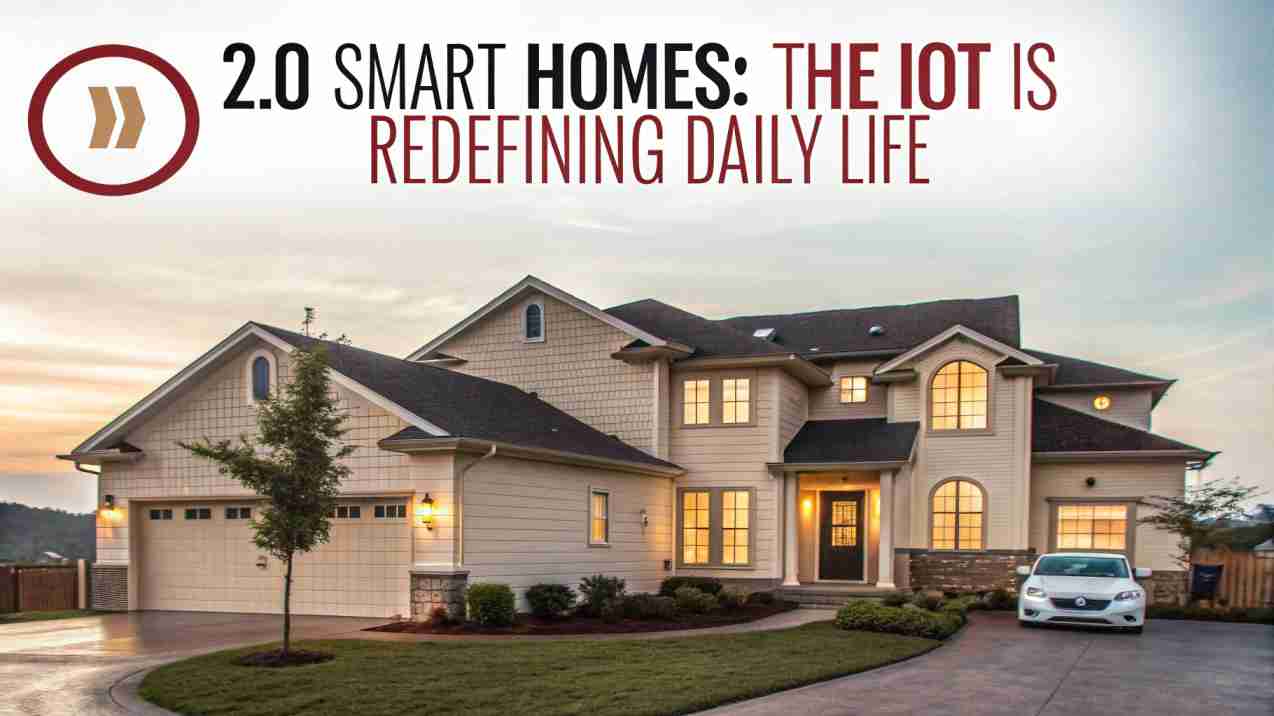
2.0 Smart Homes: The IoT is redefining daily life
And, imagine you get home after a long day. The lights switch on, your preferred playlist is started, and the room temperature is set to the standard which you like. Sounds like a dream? It is coming true thanks to the Internet of Things (IoT). The use of Smart home technology is making our homes more comfortable, efficient and connected than ever before.
What Is a Smart Home?
A smart home is a house with devices built in that are capable of communicate between themselves and the internet. These devices could be programmed to work via a smartphone, with voice recognition, or it could be automated, based on your habits. Think of intelligent thermostats, video doorbells, robotic vacuums, or voice assistants, such as Alexa and Google Home. All these devices are interconnected to simplify and streamline life.
How IoT Connects Everything?
It can all be possible with the help of the Internet of Things. IoT allows connecting everything that people can use to the internet, including lights, fridges, and even coffee makers. These devices will collect the data, analyze your pattern, and self-modify.
Your intelligent thermostat, say, can be programmed to turn the heating down when you go to work to save energy. Your smart fridge will also be able to monitor expiry dates and suggest recipes to its owner based on what it has. You may call it a 24-hour personal assistant.
Benefits of Smart Homes
Smart homes are convenient, secure and environmentally friendly.
Convenience: You can control your whole house with 2 or three button presses of your phone or by saying a command.
Security: These new security cameras, door locks, and motion sensors will help keep your home safe even when you are not home.
Energy Efficiency: Unused lights can be turned off automatically using automated systems or heating and cooling can be adapted to the most efficient levels.
This all equates to a more comfortable, greener and safer lifestyle.
Challenges and Concerns
Smart houses are not perfect but they sound awesome. The largest issue is privacy. They are always on and monitor details about your habits and routine. Otherwise, this can be abused. The second problem is compatibility, not all devices are compatible with another, especially when they are of different brands.
There’s also the cost factor. Smart devices might be expensive initially, but can also be cost-effective in the long-run due to their energy-efficiency.
The Future of Smart Living
The Smart Homes 2.0 will be even smarter than the earlier generation of smart homes. Artificial Intelligence (AI) will make a huge difference, and your house will read your mind instead of acting on your orders. Examples include having relaxing music on at your house when your fitness tracker says you are stressed, or turning the lights off at bedtime.
Within a relatively short time, all devices will be interconnected and we will all experience a fully personalized experience in our homes that can adapt to each person on-demand.
Conclusion
Smart homes have ceased being a cool concept and have become a way of life. With IoT, our homes are becoming living systems, which know us as they are beginning to connect everything around us. The future of smart living is not completely dark, but there is a number of issues to be considered.
In the near future, you might just have to tell your home assistant, Alexa, I am home and see your house appear.