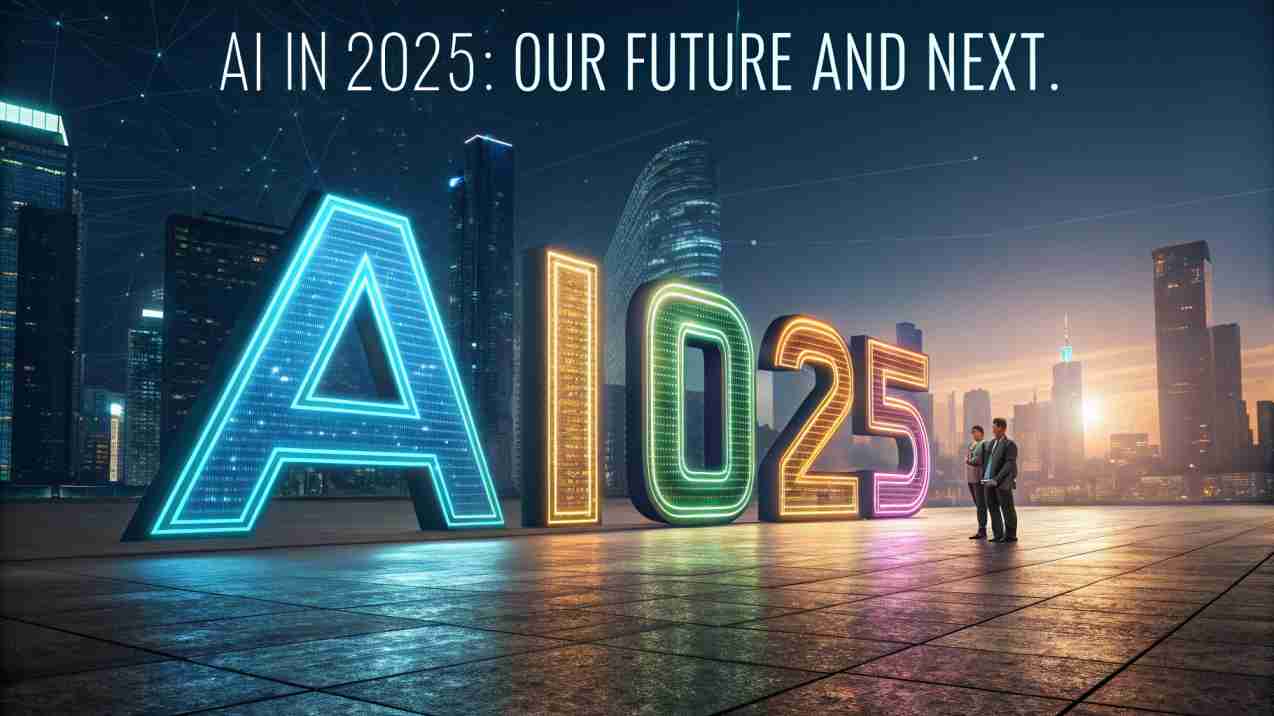
AI in 2025: Our Future and Next.
As Artificial Intelligence, or AI, the idea of the future is gaining an important part of our lives. AI is ubiquitous, whether in conversations with chatbots and voice assistants or the personal recommendations provided on the Internet. In 2025, it will be smarter, faster and more connected than ever before and will change the way we live, learn and work. But where are we at and where do we go?
The Big Picture: AI Today
The year 2025 will not be about robots and self-driving cars. It is an awesome utility which helps computers think and learn with data. Modern AI can even compose stories, draw art, decipher medical data and even converse in a way all too human.
Businesses are forecasting customer actions using AI, physicians are detecting diseases early and students are getting help with their assignments. AI is not a distant dream anymore, it is a reality.
Changing Industries with AI.
AI has transformed almost every important field:
Healthcare: AI will read X-rays, analyze disease, and help a doctor find better cures.
Education: AI learners and learning applications alter lessons to match the pace of the individual student.
Business: Marketing tools, data systems, and chatbots help companies to run smoothly.
Entertainment: AIs now generate entertainment as music, art and writing which is sometimes even hard to tell.
Farmers are intelligent and effective and can now use AI drones and sensors to survey crops and predict weather patterns.
The Power of Generative AI
One of the biggest finds of the last several years is generative AI, or technology used to create new content, including text, art, and music. ChatGPT, Midjourney, and DALL can create original images, write essays or generate ideas in a few seconds.
This has made tools that were previously open to only professionals accessible to all people, enabling innovative minds to be opened to writers, designers and students. But it also brings fresh questions concerning originality, copyright and creativity.
The Challenges We Still Face
AI cannot be considered perfect in its power. It can make mistakes, misinformation, or show biases which are reflected in its training data. That is why it is necessary to make AI ethical, as there should be fairness, transparency, and responsibility in the technology, says experts.
Privacy is another concern. Since AI systems are being trained on the data, personal information security has become more vital than ever. Governments of different nations are now in the process of designing AI regulations that make this type of systems safe and sound.
What’s Next for AI?
The future artificial intelligence will be more personal and active. It will shortly tell you what you require before you ask it, as to planning, proposing an ambition, or regulating your health, without your expecting to ask it. The AI will assist in climate science, space research, and all-purpose education too.
Human and AI at work: the future will see a time when humans and artificial intelligence will work together in performing tasks, but not to substitute each other, but to help humans realize their full potential.
Conclusion
In 2025, AI would not be a fashion in technology, rather it would be a global trend that shapes how we live and think. Possibilities are limitless, so are the challenges. When used correctly, AI can act as one of the most effective tools ever to fall into the hands of humanity, not only improving the world but also turning it into a more intelligent and better one.