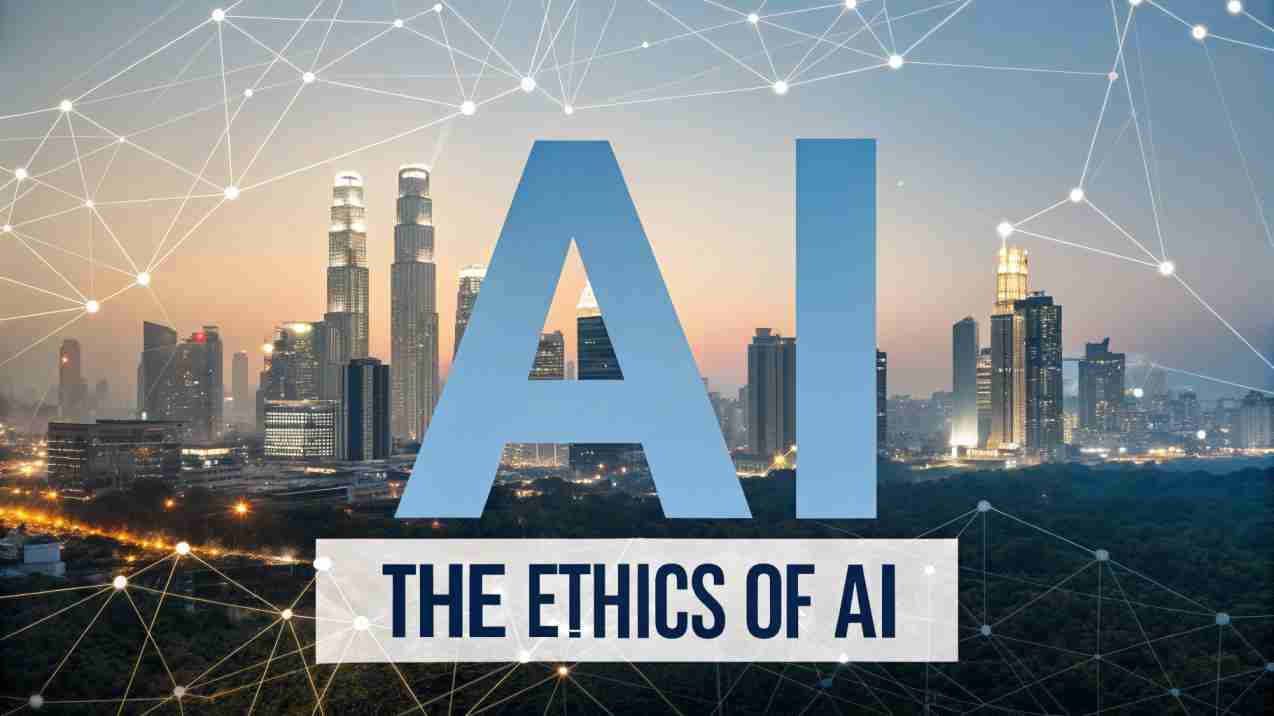
The Ethics of AI
Is it possible to teach Machines morals?
Artificial Intelligence (AI) is becoming smarter every year. It helps doctors to diagnose diseases, processes to automate and move independently, and companies to make better decisions. But with increased intelligence of AI, one of the major concerns is whether machines will be able to differentiate between right and wrong. Here is where AI ethics may come in. It is all about making technology fair, honest and harmless to everybody.
What Does “AI Ethics” Mean?
AI ethics is a collection of rules and principles indicating how AI systems should act. Since AI systems are data driven they are soulless and immoral. They follow patterns.
To illustrate, in instances where an AI receives biased information, like when shown more job opportunities to men as compared to women, a certain AI might find itself making biased judgments without even knowing it. That is why the process of human development and training AI must be done responsibly, with the principles of fairness and equality in mind.
Why AI Ethics Matters
Currently, AI is engaged in major life-related choices, including choosing employees, issuing loans, and diagnosing patients. The effects of these systems breaking down can be disastrous.
Imagine being refused a job because a robot recruitment machine misreads your resume, or a loan because of what your neighborhood looks like. The problems confirm why AI ethics is not a technology issue, but a matter of human rights and trust.
Ethical AI is essential to treating everyone equally and making sure that machines become the servants of humanity, not vice versa.
Ethical issues in AI.
Prejudice and Unbiasedness: AI has the potential to detect human biases using data. Skewed information will produce skewed scores.
Privacy: AI systems tend to study personal information. Care must be taken to protect that information.
Transparency: The vast majority of AI systems are black boxes, which is to say that we do not understand the reasons why they make the decisions that they do.
Liability: Who bears the responsibility in case of a fateful action carried out by an AI, the company, the coder or the machine?
These and similar questions make AI ethics one of the most important discussions in modern technology.
Can Machines Learn Morality?
The short answer is not yet. They are not machines that feel, do not have an empathic heart, and do not assess what is correct or incorrect. Researchers are however trying to teach AI morality by giving it specific instructions and a code of ethics.
Their ethical algorithms guide other experiments and determine whether to experiment or not, depending on human values. An example would be an artificial intelligence-based system, which can be programmed to ensure human safety is of primary importance. However, these systems are yet to be able to understand what is right or wrong; they operate based on logic.
The Global Ethical AI Initiative.
Governments and universities are partnering with tech companies to create guidelines on the ethics of AI. The goal is to provide human rights, transparency, and the security of AI systems. Organizations like UNESCO and the European Union have already developed concepts that could be deployed to develop responsible AI.
Conclusion
AI can be used in amazing ways but on the other hand, it could be destructive. Not only do we have to program machines with morality, but we also have to learn how to articulate our values and to get technology to reflect them.
Once we find ourselves in a future where AI exists we need to remember one thing machines learn about us. It is time to lead by example of ethical AI, fairness, honesty, and humanity.